.png)


Early Childhood Education Curriculum Explained: Stages, Activities & Benefits

Updated: Sep 22

The Early Childhood Education Curriculum forms the base of how young learners begin to understand ideas, communicate with confidence, explore their surroundings, and express emotions in a healthy way. These early years create habits and interests that stay with them for a long time. In this content, we look at what the curriculum means, how different stages shape a child’s growth, the core components involved, learning activities commonly used in schools, the wide set of benefits children receive, why choosing the right school matters, and how The Vivekananda School supports early learning with care and structured planning. Parents will also find a short section on simple ways to support learning at home.
What Is Early Childhood Education Curriculum?
Early childhood education curriculum is a thoughtfully organised plan that guides how children between the ages of two and eight learn in a steady, age appropriate manner. It is created to help them make sense of new ideas through structured routines, playful activities, and consistent guidance from teachers. The curriculum creates a safe environment where children feel free to try new activities, make mistakes, ask questions, and gradually build confidence.
It usually covers:
Developmental goals for each year
Ways to support thinking, communication, emotional expression, and physical growth
Activities that match the child’s age and interest
A routine that balances play, learning, rest, movement, and creativity
Opportunities for group interaction, early problem solving, and imagination
This kind of curriculum supports smoother transitions from early years to formal classroom learning.
For admissions: Day Care, Playway, Prenursery, Junior KG & Senior KG Call +91 8800902881

Key Stages in Early Childhood Education
Pre Nursery Stage (Ages 2 to 3)
During this stage, children discover the world through touch, colours, sounds, and movement. They begin responding to familiar voices, expressing their likes, and showing early interest in simple games. Schools usually aim to build comfort, routine, and early independence.
Focus areas include:
Sensory stimulation using textures, water play, and visual objects
Very short activities that match their limited attention span
Early motor development through stacking, rolling, and building
Learning to follow simple instructions
Beginning social connection with peers and teachers
Children in this age group learn best through repetition and warm guidance.
Nursery Stage (Ages 3 to 4)
Children begin showing more curiosity at this stage. They ask questions, enjoy pretend play, and start expressing opinions. Their language skills expand quickly, and they grow more comfortable participating in group activities.
This stage usually highlights:
Early vocabulary building through rhymes and conversations
Counting skills through objects, pictures, and story based tasks
Imaginative play that helps them express feelings
Social routines like greeting, sharing, waiting, and tidying up
Activities that slowly build fine motor skills such as drawing and threading
This stage prepares children to handle slightly longer routines and group tasks.
Kindergarten Stage - KG1 & KG2 (Ages 4 to 6)
Kindergarten is a transition zone where playful learning begins to meet early academics. Children start forming clearer ideas about letters, numbers, stories, and patterns. They show increased independence and interest in teamwork.
Schools usually focus on:
Phonics, early reading, and sound recognition
Number sense through patterns, counting, shapes, and measurements
Art, music, dance, and craft activities that support expression
Classroom routines such as circle time, group tasks, and simple leadership roles
Activities that build listening and comprehension skills
This stage helps children get ready for more structured learning in primary school.
Early Primary Stage (Ages 6 to 8)
At this level, children begin applying what they have learned. Their thinking becomes clearer, and they can understand slightly complex ideas. They develop stronger communication skills and begin to enjoy activities that involve reasoning.
Key areas include:
Reading fluency and story understanding
Logical thinking through puzzles and step-by-step tasks
Simple problem solving in maths, science, and general awareness
Creative projects that encourage imagination
Physical activities that improve strength, balance, and coordination
This stage builds confidence for the years ahead.
Core Components of an Effective Early Childhood Curriculum
Cognitive Development
This includes activities that encourage observation, memory building, comparing shapes, identifying differences, sorting items, and understanding simple categories. Children learn how to make sense of things they see and experience.
Social and Emotional Development
Schools help children:
Recognise and name emotions
Share thoughts with peers
Build friendships
Solve small disagreements with guidance
Develop patience and empathy
This prepares them for positive relationships.
Language and Literacy
Language forms the base for all communication. Schools support this through:
Storytelling sessions
Phonics activities
Vocabulary introductions
Picture reading
Group conversations
These activities help children express themselves with clarity.
Motor Skill Development
Fine motor skills grow through writing patterns, drawing shapes, colouring, cutting paper, and threading beads. Gross motor skills improve through jumping, hopping, running, balancing, obstacle courses, and outdoor play.
Creative and Sensory Activities
These activities allow children to explore ideas freely. Common activities include:
Clay modelling
Finger painting
Music and rhythm sessions
Sensory bins
Craft using natural materials
Children develop imagination and sensory awareness through such activities.
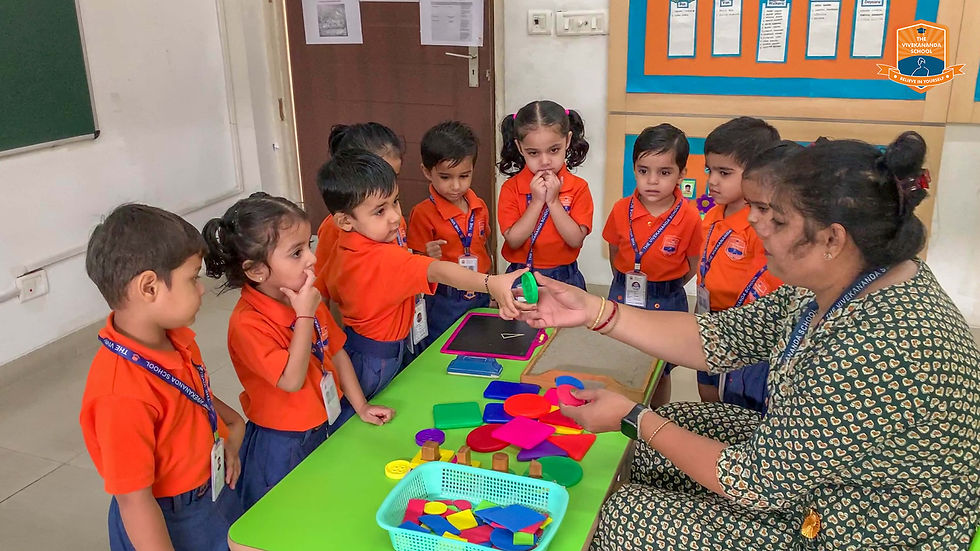
Popular Learning Activities in Early Childhood Education
Play-Based Learning
Play helps children build confidence naturally. Schools use:
Role-play corners
Pretend shops
Building blocks
Cooking play
Puppet play
Children learn social behaviour, imagination, and basic thinking skills through these spaces.
Outdoor and Nature Activities
Outdoor learning helps children stay active and enjoy nature.
Activities include:
Gardening simple plants
Sand play with moulds
Water play with cups and funnels
Nature walks with observation tasks
Free running and balancing games
Such activities keep children physically active and curious.
Story Time and Phonics Games
These sessions help children understand letters and sounds through a friendly format.
Common activities:
Reading picture books
Sound matching cards
Story sequencing games
Pretend storytelling using puppets
These activities improve listening and communication.
STEAM-Inspired Activities
Schools may introduce simple concepts through creative tasks such as:
Colour mixing experiments
Counting beads and objects
Building patterns
Shape based craft
Simple science play using safe materials
This supports thinking and exploration.
Benefits of a Well-Structured Early Childhood Education Curriculum
Strong Academic Base: Children develop reading readiness, clarity in speech, number confidence, and pattern recognition. They gain comfort with early academics through consistent activities.
Better Social Skills: Children interact with classmates, share materials, take turns, communicate needs, and participate in group tasks. This helps them feel comfortable in classroom settings.
Emotional Growth: Children learn to express feelings, calm themselves, show care for others, and feel confident in new situations.
Better Physical Coordination: Morning drills, outdoor games, movement activities, and craft work help children improve balance, posture, and hand control.
Love for Learning: Children grow curious, enjoy new experiences, and show interest in tasks that involve thinking, reading, and creating.
Early Childhood Education at The Vivekananda School
The Vivekananda School offers a warm and well-structured early learning environment where children feel safe, supported, and ready to explore new ideas. The Early Years Foundation Stage program, child-friendly infrastructure, and a balanced 25:1 student-teacher ratio help create a steady start for young learners.
Some key features include:
Govt. approved health and safety protocol
Experiential learning through hands-on activities
Montessori Activity Hall for holistic growth
Creative corners like the Dance Studio and Music Studio
Vivekian Organic Garden for natural learning experiences
The school also provides a well-equipped daycare with an in-house kitchen for children aged six months to twelve years, operating from 7:30 am to 6:30 pm. A dedicated math lab makes early numeracy more engaging through practical activities.
Recognised as the Most Trusted and best Preschool in Gurgaon, The Vivekananda School continues to focus on meaningful early childhood education supported by caring teachers and organised routines.
Conclusion
The Early Childhood Education Curriculum has a significant role in shaping how young learners think, communicate, and interact with others. A clear and thoughtfully planned curriculum supports children through each stage of growth and prepares them for later schooling with confidence. Families looking for a warm and well guided early learning space may consider The Vivekananda School to support their child’s development through these meaningful early years.
Frequently Asked Questions (FAQs)
How important is play-based learning for young children?
Play-based learning helps children explore ideas, understand emotions, interact with peers, and develop thinking skills without pressure. Through pretend play, building games, puzzles, and art activities, children learn at a natural pace and grow more confident.
How do I choose the right early learning school for my child?
Parents can look for schools with trained teachers, safe and organised classrooms, age appropriate activities, positive routines, and an approach that supports both academic learning and personal growth. Visiting the campus, observing classrooms, and interacting with teachers also helps in making a clearer decision.
How can I contact The Vivekananda School for admission?
To enquire about admission or to begin the process, you can call the school’s admissions counsellor at +91-9560102881, or you may also write to us at thevivekanandaschool@gmail.com for guidance on forms and visiting the campus.
What is the ideal age for admission to early learning programs?
Early learning programs usually start from 2 to 3 years of age
Age criteria may vary depending on the selected program
Children benefit from structured play and guided activities at this stage
Focus is on social, emotional, physical, and cognitive development
What facilities and safety measures does the school provide for young children?
Child-friendly and well-organised classrooms
Secure and monitored school premises
Trained and caring teaching staff
Age-appropriate learning materials and play equipment
Supervised play areas for safety
Hygiene and cleanliness protocols are followed daily
A nurturing and comfortable environment for children


Comments